Chapter 9
Running it: the register, the card, the cadence, what goes wrong, and the objection
The forty-eight levers are arithmetic once the cards are true. This chapter is the mechanism that makes them true in order: who owns what, how value is measured, what the board sees, the failure modes with their countermeasures, and the strongest case against the whole enterprise.
Chapter 9 of 10Running it14 min
The transformation office
Two or three people, reporting to the chief executive with a dotted line to the chairman: a transformation lead who owns the value plan and the agent register, and one or two forward-deployed engineers who build, integrate and evaluate agents alongside the function leads. The model is the one the larger sponsors have started to formalize; Thoma Bravo's April 2026 arrangement with Google Cloud gives its portfolio "teams of Google forward deployed engineers to rapidly solve deep technical challenges" rather than a central team that takes requests.1 The office owns no P&L line; the function leads do. The office owns the measurement.
That division is the single most important design decision in the program, and the failure mode it prevents is the one FTI's data describes: 66% of leaders reporting benefits, 31% calling the implementation efficient, 7% of companies at enterprise scale.2 A transformation office that owns the initiatives becomes the place function leads send AI to happen to someone else.
Ownership
| Area | Owner | Accountable for |
|---|---|---|
| Value plan and bridge | Chief executive, with the transformation lead | Delivery of the P&L bridge |
| Pricing and packaging (P8, R1, R3) | Chief executive, pricing council | Price realization, attach, uplift retention |
| Product and Invent levers (R2, R8, R9, R10, C2) | Head of product | Hours saved per customer, module and fintech revenue, attach |
| Support, success and cost to serve (G1, G6, R4, R5) | Head of customer | Cost per ticket, true resolution, gross and net retention |
| Implementation and services (G2, G3) | Head of delivery | Time to go-live, hours per customer, services margin |
| Engineering levers (O1, O2, G4, G5) | Head of engineering | Releases, coverage, change failure rate, R&D ratio, inference cost |
| Finance, legal, HR and procurement levers (O6 to O12, C1) | Finance lead | Close, DSO, no-touch rates, G&A ratio |
| Sales and marketing engine (R6, R7, O4, O5) | Head of revenue | Meetings, pipeline, cost per meeting and lead |
| Compliance, security, AI governance, data rights (O9, X1, X2, X3) | Finance lead with the IT and security lead | Certifications, the risk analysis, the register's regulatory fields |
| Add-ons and continuous diligence (X4, X5) | Chief executive with the deal team | Integration cost and time, price paid |
| Agent register and evaluations (O13) | Transformation lead | Every production agent passing, scoped and owned |
| Exit readiness (X6) | Chief financial officer | The ledger current, the AI claims substantiated |
Function leads carry their P&L line targets from the bridge in their compensation. Success is paid on net retention, sales on productivity, engineering on releases and quality together. Every employee completes the AI-skills curriculum in the first ninety days and has agent use in their role expectations by month six. The redeployment commitment is made in writing: people whose work is automated in the first eighteen months are offered a role in growth work first.
Cadence
Weekly: the business review generated Monday from the warehouse, a thirty-minute executive meeting on variances and decisions, and a transformation-office stand-up with function leads on live initiatives. Monthly: the value review, where every initiative is judged against its baseline and target and kill decisions are taken; the agent register review of evaluations, incidents, cost and scope changes; and the pricing council. Quarterly: board reporting on the bridge; a risk and compliance committee (chief executive, finance lead, IT and security lead, outside counsel as needed) on AI incidents, regulatory changes and the risk analysis; and the redeployment and headcount plan review. Annually: the P4 exposure judgment revisited and the exit ledger (X6) refreshed.
The KPI tree
Enterprise value sits at the top; below it, ARR growth, EBITDA margin, gross and net retention and AI attach as the four drivers buyers price, with gross profit and net take added for any company with a payments line; below those, the lever metrics from the cards; below those, the agent-level metrics in the register. Every metric has a source, an owner and a target by quarter, and the weekly review shows the tree with variances. NIST's framing of measurement applies: the Measure function "employs quantitative, qualitative, or mixed-method tools, techniques, and methodologies to analyze, assess, benchmark, and monitor AI risk and related impacts," and the register is where that happens for value as well as risk.3
The initiative card
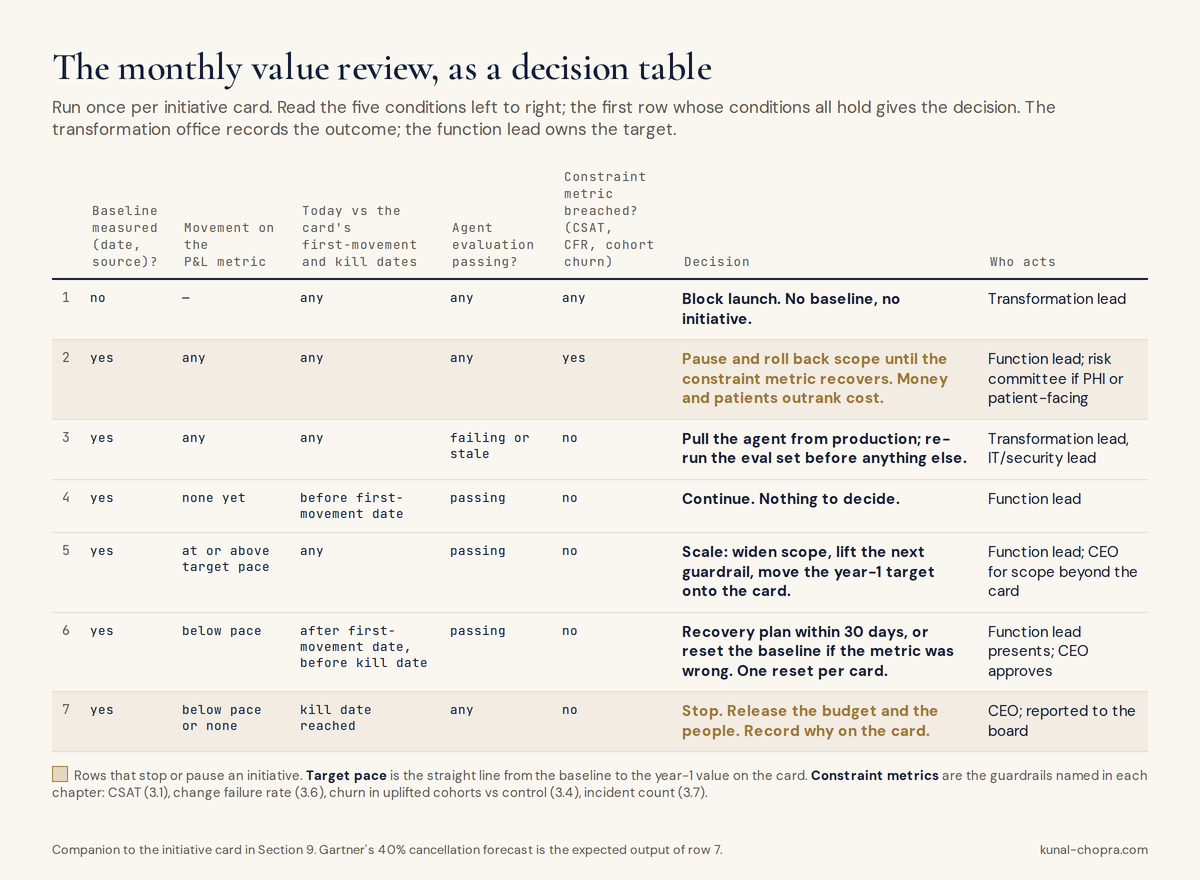
Every initiative in the value plan is described on one card, maintained by the transformation office and reviewed monthly. The fields are fixed so that initiatives can be compared and killed on evidence.
| Field | Content |
|---|---|
| Name and lever | One line; the lever identifier it executes (R8, O6) |
| Horizon | Deploy, Reshape or Invent |
| P&L line and metric | The line it moves and the operating metric that proves it |
| Baseline | Measured value at start, with date and source, from the company's own data |
| Target and date | Year one and year three values from the card, and the date by which first movement must show |
| Value at target | Annualized dollars, points of retention, or days of working capital |
| Owner | The function lead; the transformation office is never the owner |
| Build or buy | Vendor selected, or the build justification |
| Prerequisites | Data, systems, policy, rights or people required first |
| Guardrails | Human approval points, regulated-data handling, disclosure and sign-off rules |
| Evaluation | Test set, threshold and re-evaluation triggers for any agent involved |
| Kill date | The date the initiative is stopped if the target metric has not moved |
| Status and last measurement | Updated monthly |
The value creation plan template
The plan is the carrying levers from Part V for the company's archetype, in the order the horizons require, with each on a card. The case study's fourteen-initiative plan is the worked example. The template below is the shape for any company; the rows are filled from the cards.
| # | Initiative | Lever | Horizon | Year-three value | Start |
|---|---|---|---|---|---|
| 1 | The pricing reset and tier program | P8, R1 | Deploy then Reshape | Revenue at 90% flow-through | Diligence, executed Q2 |
| 2 | The foundation | P7 | Deploy | Enables all | Q1 |
| 3 | The Invent lever for this archetype | R2 / R8 / R10 / C2 / G3 | Invent | Revenue and the multiple | Q1 design, general availability inside twelve months |
| 4 | Support resolution | G1 | Deploy then Reshape | Gross margin | Q1 |
| 5 | Finance close, AP and collections | O6, O7, C1 | Deploy | G&A and cash | Q1 |
| 6 | Engineering gates and throughput | O1 | Deploy | R&D | Q1 |
| 7 | The archetype's second carrying lever | From Part V | Reshape | Per card | Q2 |
| 8 | Retention and expansion | R4, R5, G6 | Reshape | Revenue | Q2 |
| 9 | Hosting, FinOps and inference cost | G4, G5 | Deploy | Gross margin | Q1 |
| 10 | Compliance operations and AI governance | O9, X2, X3 | Deploy | Risk and the sales cycle | Q1 |
| 11 | The sales and marketing engine | R6, R7, O4, O5 | Deploy | Revenue | Q2 |
| 12 | People operations and redeployment | O10 | Deploy | G&A and the headcount plan | Q1 |
| 13 | Migrations and add-on integration | O2, X4 | Reshape | R&D and combined-scale savings | Year 1 to 2 |
| 14 | The register and the weekly review | O13 | Deploy | Executive capacity, and the exit ledger | Q1 |
Sequencing
The order matters more than the list. Foundation before agents, pricing before automation, customer-facing product inside the first year, headcount changes after retention is secured.
Days one to one hundred: baselines from actual data, the transformation office stood up, the systems and data inventory, the provider agreements signed, the platforms selected for support, finance and engineering, the AI use policy published, the plan announced to the company with the redeployment commitment in writing; the warehouse live with billing, CRM, usage and support joined at the account level; the knowledge base rebuilt; coding agents and test generation live with the review-capacity plan; close automation and collections configured; usage instrumentation shipped; the support agent live with its evaluation harness; the pricing council formed. At the day-one-hundred review every initiative shows a baseline and a first measurement, and three numbers have moved.
Days one hundred to 365: the onboarding agents on every new implementation; health scoring live and success paid on net retention; the outbound engine live with human approval; the contract platform live; the Invent lever in beta at design partners, then generally available and attached to the upper tiers; the new tiers announced and the first renewal cohort uplifted against a control; support at 40% true resolution; finance closing in six days; the first role changes through attrition; the year-one value review against the bridge.
Years two and three: the second and third Invent levers; usage or hybrid elements for new customers; support and success merged; finance on two people; migrations and any add-on integrated; headcount at the year-three plan through attrition and redeployment; the exit ledger current.
What goes wrong
The failure modes are known, and each has a countermeasure in the cards.
Pilots that never touch the P&L. MIT NANDA's finding that sales and marketing captured about 70% of AI budgets while back-office deployments "delivered faster payback periods and clearer cost reductions" describes tools chosen for visibility rather than return.4 Countermeasure: every initiative carries a P&L line and a kill date, and the back-office levers with proven returns are deployed first.
Automating before repricing. The company makes implementation faster and cheaper, then keeps billing hours. Countermeasure: P8 precedes G2 in every company.
Cutting support quality to hit a cost number. Klarna's reversal is the reference case. Countermeasure: true-resolution measurement, CSAT as a hard constraint, humans on anything that touches money, patients or employment.
Velocity without quality. Faros's 2026 data: more throughput, more bugs, fivefold review time, more incidents per pull request; GitClear's: duplication up 81%, refactoring down 70%.5 Countermeasure: test generation and review agents before coding agents scale, change failure rate as a gate, no agent merging to production.
Building what should be bought. Internal builds reached deployment half as often as purchased tools in the MIT sample.4 Countermeasure: build only where the workflow is the product or the data is proprietary.
Agent washing, in both directions. Gartner counts roughly 130 real vendors among thousands; 11x invented customers; the deflection benchmarks that circulate have no source.6 And at exit the SEC's cases against Nate (automation claimed at 93% to 97% with humans processing the transactions) and Presto (third-party technology presented as in-house) are the buyer's two questions.7 Countermeasure: paid pilots with measured outcomes before annual commitments, reference calls with named customers, and no AI claim in the exit materials without a measurement in the register.
Revenue leakage through the transition. Customers bought from the founder; the change of control and the first price increase are the moment they look elsewhere. Countermeasure: no headcount reductions in the first two quarters, a founder transition agreement, uplift cohorts with controls, visible new value before any increase.
Regulated data in the wrong place. One employee pasting a patient record, a cardholder number or an employee file into a consumer tool is a reportable event. Countermeasure: the gateway, the block list, the policy, the training and the logging in P7 and X3.
The transformation office becomes the owner. Function leads treat AI as someone else's project. Countermeasure: the office owns measurement and engineering support; the function lead owns the target and carries it in compensation.
Stopping at Deploy. The company buys tools, saves some cost and never ships a product customers pay for; competitors buy the same tools and the margin advantage evaporates. McKinsey's data says the market prices this outcome at almost nothing.8 Countermeasure: the Invent lever ships inside twelve months, and 40% of engineering capacity is on customer-facing AI by year three.
Facilitating too early. The payments company registers as a facilitator before its volume clears the break-even and spends two years and seven figures to keep a spread the processor would have shared. Countermeasure: referral first, the facilitator decision deferred to a written volume threshold.
Migrating pricing before measuring the funnel. The product-led company moves to credits and watches net additions fall in the same quarter, as HubSpot's did.9 Countermeasure: cohort by cohort, with R3's kill criteria and a control.
Cutting the content team before proving the engine. The compliance company reduces its analysts to a reviewer or two and ships a determination that cites a regulation which does not exist. Countermeasure: the rules engine is deterministic where it can be, tested against the analysts' own prior determinations, and the team shrinks by a third, not two-thirds.
Inference eating the margin. The AI product grows and gross profit does not. Countermeasure: G5's per-feature cost of goods through the gateway, routing to the cheapest model that passes the evaluation set, and the 50%-of-attributable-revenue kill rule.
Cutting services before subscription replaces them. The services-heavy company converts hours to subscription faster than the subscription grows and reports a shrinking business. Countermeasure: G3's kill criterion, and an exit narrative built on mix from year one.
The objection
The strongest case against this document is that the aggregate evidence for AI productivity is small, and that a bridge built on vendor case studies is a bridge built on survivorship. Humlum and Vestergaard, using Danish administrative data on 25,000 workers across eleven exposed occupations, "estimate precise zeros: AI chatbots have had no significant impact on earnings or recorded hours in any occupation," with "modest productivity gains (average time savings of 3%)," and their 2026 revision still rules out effects larger than 2% two years after the technology's public launch.10 Acemoglu's calibration puts the macro effect at "no more than a 0.66% increase in total factor productivity (TFP) over 10 years."11 Bain and StepStone's 2026 survey found that "within portfolio companies, benefits skew toward cost savings, with nearly 40% of GPs not expecting material financial impact from AI in 2026."12 Meritech's index shows the companies with AI tailwinds falling further than the rest.13 And the study most often quoted for the failure rate, MIT NANDA, rests on 52 interviews and a 153-person survey, with "success" defined as executives having "remarked" on a sustained impact within six months; critics have pointed out that the 5% may rest on two or three companies.14 If the aggregate effect is 3% of hours and the headline failure rate is unreliable, why should any owner plan on fifteen points of margin?
The objection is right about three things, and the playbook is built around them. It is right that task-level gains are uneven and concentrated in specific work: Dell'Acqua's preregistered experiment with 758 consultants found those using AI "completing 12.2% more tasks and completing them 25.1% more quickly" inside the frontier of what the model could do, and "19% less likely to produce correct solutions" on a task outside it.15 That is why the cards pick their tasks narrowly (reconciliations, tier-one tickets, test generation, appeal packages, contract extraction) and refuse others (medical necessity, care plans, coverage decisions, hiring decisions, merges to production). It is right that wage and hours effects at the economy level lag firm-level changes, which is precisely why a firm that does redesign its roles captures the gain that the average firm does not; the 3% is the average over firms that mostly did nothing with the time saved. And it is right that vendor evidence is survivorship-biased, which is why every card is graded, why the weak-graded levers are run as internal measurement programs, and why every initiative has a kill date.
Where the objection is wrong is in what it measures. The margin in any of the five bridges does not come from 3% time savings distributed across the headcount. It comes from four or five discrete structural changes: implementation repriced into the subscription, a support function that resolves most of its volume without a person, a finance function of two, a codebase with test coverage, a payments rail the customer's money runs through, a product tier the customer pays more for. Each of those is a role redesign or a pricing decision, and none of them is what a chatbot-adoption survey measures. The honest version of the claim is narrower than the enthusiasts' and larger than the skeptics': the technology delivers small gains on average and large gains where a company reorganizes around it, and the entire point of owning the company is that you get to reorganize it.
What this means for the operator and the board
Three decisions follow, and they are decisions rather than exhortations.
The first is made before close: the carrying levers are underwritten with baselines (P5), the pricing change is diligenced alongside the technology (P8), the data rights are counted (P2), and the bridge is not approved without them. A plan that automates implementation without repricing it, or ships AI features without tiers to attach them to, or claims a data moat the contracts do not grant, has given away the largest lever in the document.
The second is made in the first hundred days: the foundation (P7) is funded as a single line and built before most agents go live, and the board asks the day-one-hundred review for three moved numbers, not a list of tools installed.
The third is made every month until exit: the value review kills initiatives on their dates. Read Gartner's 40% cancellation forecast as a description of hygiene rather than a prediction of failure.6 A company that has cancelled six initiatives on schedule and kept eight that moved their lines is running the plan. A company with fourteen initiatives all "in progress" at month eighteen is running the one most companies are handed.
The bridges in Part V are arithmetic once the cards are true. The work is making the cards true, in order, with the customer paying for the parts the customer values, and a person signing everything that touches money, patients or people's jobs.
— Kunal
Sources
- Thoma Bravo, "Thoma Bravo and Google Cloud Launch Strategic Partnership," April 15, 2026. https://www.thomabravo.com/press-releases/thoma-bravo-and-google-cloud-launch-strategic-partnership-to-deliver-on-the-promise-of-ai-for-enterprise-software (V)↩
- FTI Consulting, 2026 Private Equity Value Creation Index, June 4, 2026, and 2026 Private Equity AI Radar, May 19, 2026. https://www.fticonsulting.com/about/newsroom/press-releases/ai-speeds-up-returns-in-private-equity-as-ma-becomes-top-value-generator-for-firms ; https://www.fticonsulting.com/insights/reports/2026-private-equity-ai-radar (I)↩
- NIST, AI Risk Management Framework 1.0, January 2023. https://nvlpubs.nist.gov/nistpubs/ai/NIST.AI.100-1.pdf (I, standard)↩
- MIT NANDA, The GenAI Divide, July 2025. https://mlq.ai/media/quarterly_decks/v0.1_State_of_AI_in_Business_2025_Report.pdf (I, methodology contested; see 14)↩
- Faros AI, The AI Productivity Paradox 2026, https://www.faros.ai/research/ai-acceleration-whiplash (I, vendor telemetry); GitClear, "The Maintainability Gap," January 2026, https://www.gitclear.com/the_ai_code_quality_maintainability_gap (I, vendor dataset)↩
- Gartner, June 25, 2025, https://www.gartner.com/en/newsroom/press-releases/2025-06-25-gartner-predicts-over-40-percent-of-agentic-ai-projects-will-be-canceled-by-end-of-2027 (I); TechCrunch on 11x, March 24, 2025, https://techcrunch.com/2025/03/24/a16z-and-benchmark-backed-11x-has-been-claiming-customers-it-doesnt-have (I); servicedeskagents.com, "AI Service Desk Deflection Rates 2026," https://servicedeskagents.com/deflection-rates/ (I)↩
- Global Investigations Review, "US enforcement agencies intensify scrutiny of AI washing," 2026. https://globalinvestigationsreview.com/review/the-investigations-review-of-the-americas/2026/article/us-enforcement-agencies-intensify-scrutiny-of-ai-washing (I)↩
- McKinsey, "Beyond productivity: How AI creates value in private equity," June 23, 2026. https://www.mckinsey.com/capabilities/business-building/our-insights/beyond-productivity-how-ai-creates-value-in-private-equity (I)↩
- HubSpot Q2 2026 earnings call, August 12, 2026. https://www.fool.com/earnings/call-transcripts/2026/08/12/hubspot-hubs-q2-2026-earnings-call-transcript/ (I, public company)↩
- Humlum and Vestergaard, NBER Working Paper 33777, revised March 2026. https://www.nber.org/papers/w33777 (I)↩
- Daron Acemoglu, "The Simple Macroeconomics of AI," NBER Working Paper 32487, May 2024. https://www.nber.org/papers/w32487 (I)↩
- Bain & Company and StepStone Group, 2026 Private Equity GP Outlook, March 2, 2026. https://www.bain.com/insights/private-equitys-reality-check-gp-outlook-2026/ (I)↩
- Meritech Capital, "Meritech Software Pulse," April 9, 2026. https://meritech.substack.com/p/meritech-software-pulse-09-april (I)↩
- Futuriom, "Why we don't believe MIT NANDA's weird AI study," August 26, 2025; 80,000 Hours podcast, April 28, 2026. https://www.futuriom.com/articles/news/why-we-dont-believe-mit-nandas-werid-ai-study/2025/08 ; https://80000hours.org/podcast/episodes/ai-workplace-mit-study/ (I, critique)↩
- Dell'Acqua et al., "Navigating the Jagged Technological Frontier," Organization Science, March 11, 2026. https://www.hbs.edu/ris/Publication%20Files/dell-acqua-et-al-2026-navigating-the-jagged-technological-frontier_5c589c8c-fbb5-458f-b285-c944746cd717.pdf (I)↩
Boring AI
AI for manufacturers, operators and service businesses — not startups chasing hype. Every other week.
Your address is used only to send this newsletter. No sharing, no selling, no tracking pixels. Unsubscribe from any issue.